01
DICOM & RT-DICOM
CT, MR and PET series, RTSTRUCT, RTDOSE, photon and ion RTPLAN, DICOM SEG, planar images, spatial and deformable registrations and treatment records, from folders or single files, with or without a volume.
A native DICOM and radiotherapy station for research, analysis and QA, written entirely in Rust. View and compare complete RT studies, register images and propagate structures, contour and auto-segment, analyse dose and 4D motion, keep your own PACS, and automate it all with workflows or an AI assistant, on Windows, Linux, macOS, Android tablets, iPad and iPhone.
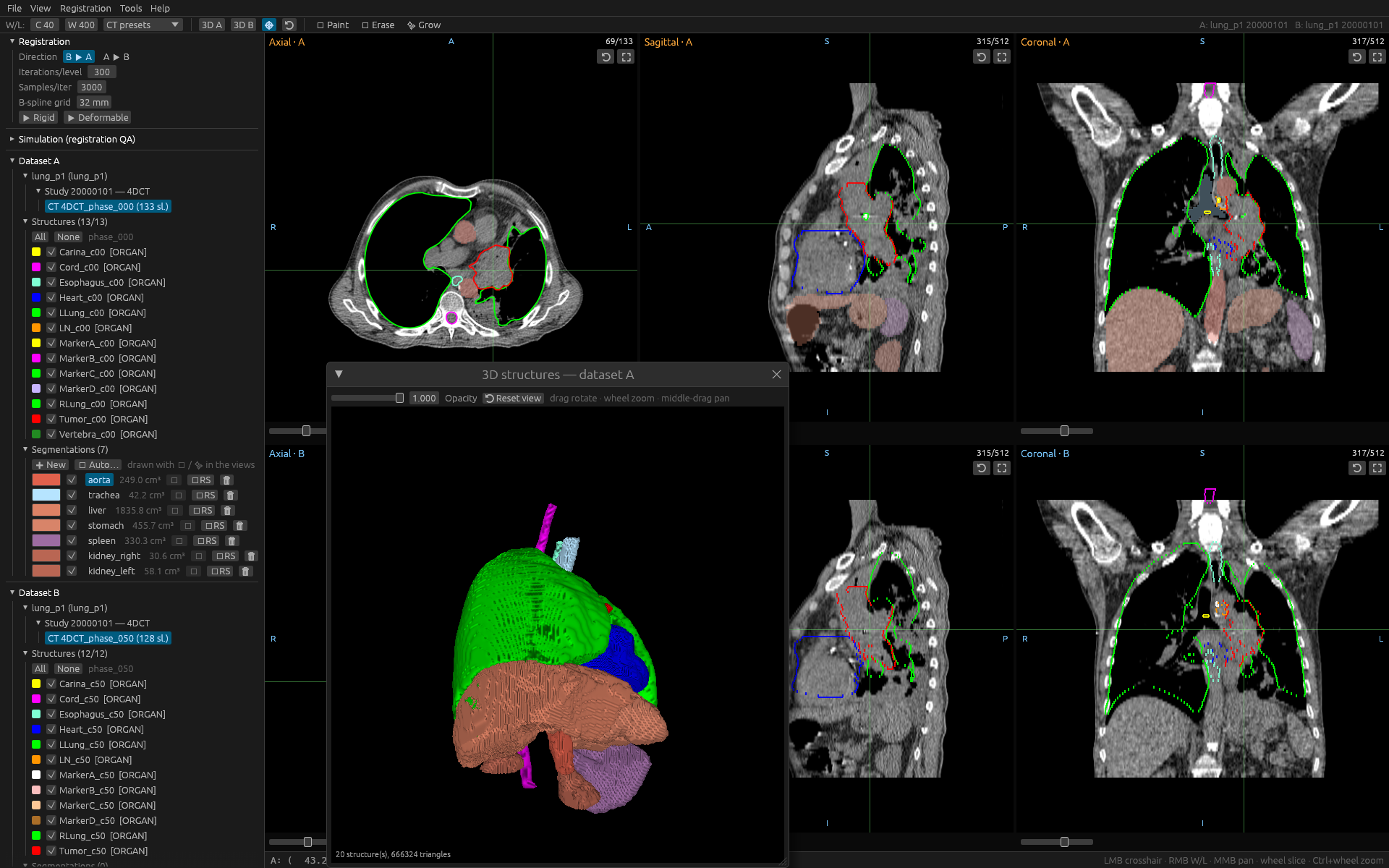
Load complete studies, inspect image geometry, compare workspaces, work with radiotherapy objects, keep patients in a PACS and run analysis workflows from one native application. Every engine, from registration to the segmentation networks, is re-implemented in Rust, with no Python or C++ framework behind it.
CT, MR and PET series, RTSTRUCT, RTDOSE, photon and ion RTPLAN, DICOM SEG, planar images, spatial and deformable registrations and treatment records, from folders or single files, with or without a volume.
Patient-space axial, sagittal and coronal views in rows you lay out yourself, the 3D scene among them, and up to four workspaces side by side with the crosshair, slice and zoom synced.
Rigid and B-spline after elastix, dense B-spline and landmark warp after plastimatch, and registration by structures, with Dice, displacement statistics, Jacobian, vector fields and fusion.
Phase grouping, registration, structure propagation, motion metrics, ITV generation, structure comparison and CSV export, and cine playback through the phases of a 4D group.
Polygon, spline, freehand, brush and live-wire tools with interpolation, Boolean operations with margins in patient directions, generators from grey levels or isodose, and the body contour on CT and MR.
81 automatic models (TotalSegmentator, the nnU-Net v1 tumour models, MRSegmentator, lungmask, MONAI, CT-FM, VISTA-3D, NV-Segment-CTMR), your own nnU-Net models, and the prompt engines SegVol, MedSAM2 and nnInteractive, all rebuilt natively for the CPU or any GPU.
Dose colorwash and isodose lines, cumulative and differential DVHs with D95%, D2cc and V20Gy metrics and protocol constraints, and DRRs with a beam's-eye view from an RTPLAN beam.
The program's own steps wired into a graph in a node editor, saved as a small file and run again on other data: in the background, step by step in the viewer, or as a batch over a folder of patients.
This station's PACS shows cohorts, patients, studies and series from one or more storage folders with one catalog; select several rows to load, rename, move between cohorts or into other folders. The optional rds-pacs server shares it with other stations over HTTPS.
Through the Model Context Protocol (MCP), assistants can load, segment, register, propagate, analyse and export DICOM data programmatically, including saved workflows and processing across entire cohorts, with patient identifiers kept out.
DICOM export with an editable tag table, a folder anonymizer with consistent UID regeneration, a model manager for every downloadable weight and a synthetic RT-study generator.
The same viewer on Windows, Linux, macOS, Android tablets, iPad and iPhone, drawing through wgpu (Vulkan, DirectX 12, Metal or OpenGL); a CPU-only build runs without the GPU inference backend.
Explore the architecture and the workflows available in the viewer.
Download the latest release for your platform, or install it with winget on Windows and from the Snap Store or Flathub on Linux.

Windows x64 · Installer

Linux x64 · AppImage

macOS 12+ · Disk image

Tablets, Android 11+ · APK
iOS / iPadOS 15+ · IPA
The same release, kept up to date by the package manager.
winget install RDS.RustDICOMStationwinget upgrade RDS.RustDICOMStationsudo snap install rust-dicom-stationflatpak install flathub io.github.alexprotom.rust-dicom-station.ipa installs through TestFlight,
an ad hoc profile, or a tool that re-signs it with your own Apple ID
(how).The documentation lives in the repository and is linked directly below, so these links always take you to the canonical source documents.
Contributors are loaded directly from the public GitHub repository, while project contacts can be maintained manually below.
Click on a contributor to visit the GitHub profile.
Contributions, bug reports, feature ideas and improvements are welcome. Start by exploring the repository and its development workflow.
Fork the repository, create a focused branch, make your changes and open a pull request. Keep changes consistent with the existing Rust architecture and test suite.
Fork on GitHub ↗Found a bug or have a reproducible problem? Open an issue with the operating system, application version, steps to reproduce and relevant logs.
Open an issue ↗